Grow · Glossary · Updated: September 2026
The market, in plain words
The terms of Uruguayan farming and its wholesale market, explained for people outside the sector. With this you can read a price bulletin, the planting-intentions report, or a conversation between stallholders, without getting lost.
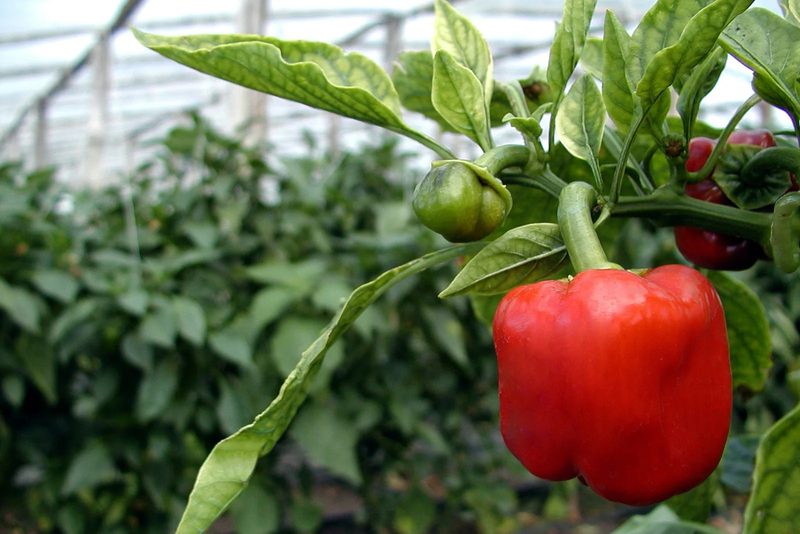
Peppers under cover · photo: Marcelo Cattani
01 / 04
Growing
Zafra (season)
A crop's season: the part of the year when it is planted, harvested and sold. "La zafra de la cebolla" is the stretch of the year when the new onion reaches the market. Peak zafra means plenty of supply and prices that usually fall; between zafras, the opposite.
Counter-season
Growing when the other region cannot. Salto works as Uruguay's internal counter-season: when the cold stops production in the south, the north supplies the country.Key in Salto
Primor (early season)
Early production: the crop that reaches the market before everyone else's, when supply is thin and the price is high. It is Salto's historic speciality — tomatoes and peppers in winter and spring, onion a month ahead of the rest. It takes a milder climate, plastic cover and irrigation.Key in Salto
Almácigo (seedbed)
The grower's nursery: beds or trays where the plants are raised before going to their final place. When a report says 70 % of the onion "is in almácigos", it is saying that supply has not been planted yet — it is future production, not present.
Transplanting
Moving the seedling from the seedbed to the soil or glasshouse where it will grow until harvest. Weeks can pass between seedbed and transplant, which is why planting intentions give months of warning about supply.
A campo (open field)
Growing in the open air, with no protective structure. In Salto it is 77 % of the declared vegetable area: sweet potato, squash, onion, carrot.
Protected growing (under cover)
Growing inside a plastic structure that changes the climate: it protects from frost and rain, brings the cycle forward and improves quality. It is the basis of primor. Three sizes: glasshouse, macro-tunnel and micro-tunnel.
Invernáculo (glasshouse)
The large fixed structure: a plastic shed you work standing up in, with ventilation and sometimes automated irrigation. In Salto it holds the tomatoes and most of the peppers.Key in Salto
Macro-tunnel
A mid-sized tunnel: you can walk inside, but it is simpler and cheaper than a glasshouse. In Salto it is the typical structure for strawberries.
Micro-tunnel
A low tunnel covering only the row of plants; the plastic is lifted to work. Used to bring summer crops such as melon and watermelon forward.
Chacra (smallholding)
The productive holding, usually a family one. "Going to the chacra" means going to the land where things are grown. In the northern river country, horticulture is mostly family-scale with local labour.
Productive unit (UP)
The unit the surveys count: one productive undertaking (grower plus land), whether it has one hectare or fifty. Salto's winter 2026 survey covered 114 of them.
Planting intention
The area a grower declares they plan to plant in the coming months. Added to what is already in the ground, it tells you how much supply each line will have — valuable information for buying, selling or lending.
Rubro (product line)
Each product understood as a line of business: "the tomato rubro", "the leaf rubros". A grower usually works several of them to spread risk and labour across the year.
Variety
The type within a species, which the market prices separately: round, plum or cherry tomato; red, green or yellow pepper; satsuma, ellendale or murcott mandarin. That is why a price bulletin has three rows of "tomato".
Cycle
A crop's full run, from sowing to harvest. Some lines fit more than one cycle a year, which is why the annual areas in the surveys can exceed the physical area of the holding.
02 / 04
The market
Wholesale market
Where shops buy, not the public: greengrocers, corner stores, supermarkets, street-market traders and canteens stock up by the crate. "Wholesale" prices are those volume sales; the retailer adds their margin afterwards.
UAM
The Unidad Agroalimentaria Metropolitana: Uruguay's main wholesale market, in Montevideo, heir to the old Mercado Modelo. It handles around three quarters of national fresh fruit and vegetable consumption, so its prices are the reference for the whole country.
Observatorio Granjero
The agreement between DIGEGRA (the agriculture ministry) and the UAM that records prices from real transactions and publishes them on Mondays and Thursdays. It is the source of our price observatory.
Reference price
The recorded price that serves as the yardstick for the whole market. Nobody sets it: it is the record of what things actually sold for. Growers, buyers and even contracts use these references to negotiate.
Min–max
The price range for a product on the same day. There is no single price for tomatoes: there are lots of different quality, size and ripeness. The minimum and maximum mark that spread; the midpoint is a useful summary.
Puesto (stall)
A selling unit inside a wholesale market. The Central Hortícola del Norte has 75; each one is a business selling its own produce or someone else's.
Operator
The business trading inside the market. It can be a grower selling their own crop or a trader who buys and resells. At the CHN a good share of the stalls are operators — an important distinction: not everyone selling in the market grows.Key in Salto
Consignatario (commission agent)
Sells someone else's goods for a commission without buying them: the grower hands over the load "on consignment" and is paid according to what the agent manages to sell. It is the historic figure of the fruit and vegetable trade — it solves selling for the grower who cannot be at the market, in exchange for a percentage.
Commission
The percentage the commission agent keeps from the sale. Along with freight and waste, it is one of the costs that separate what the grower receives from the published wholesale price.
Bulto (crate)
The physical unit of wholesale trade: the crate, the sack, the cage. Nobody buys "a kilo of tomatoes" at the market — they buy crates. The bulletins convert those units into a price per kilo or per dozen so they can be compared.
Feria (street market)
The neighbourhood street market. The trader buys at dawn in the wholesale market and resells at the feria — one of the main customers of any horticultural market.
Wholesale-to-retail gap
The difference between the market price and what the final consumer pays in the shop. It covers freight, waste, premises and the retailer's margin. The Observatorio Granjero measures it periodically, product by product.
Merma (waste)
What is lost on the way: fruit that bruises, dries out or rots between harvest and sale. In fresh produce it is a huge, silent cost — cutting it is one of the reasons cold chambers and packing houses exist.
Cold chain
Keeping produce refrigerated without a break from harvest to sale. Every hour of heat shortens shelf life. The CHN brought cold chambers to the north — infrastructure that barely existed outside Montevideo before.
Packing
The sorting, washing, grading and packing stage that turns a harvest straight off the land into a presentable, classified product. It is the first step of added value, and the area with most room to grow around the CHN.
Freight
Moving the goods, almost always by hired lorry. For the north it was the big hidden cost: buying in Montevideo meant 500 km of freight. Saving it is one reason traders along the river went back to buying in Salto.Key in Salto
03 / 04
Institutions and rules
Central Hortícola del Norte (CHN)
The wholesale market and logistics hub of northern Uruguay, at the junction of routes 3 and 31 in Salto: 75 stalls, packing, cold chambers and logistics services. Trading since June 2026. The full profile is here.Key in Salto
Law 20,052
The 2022 act that creates the CHN and defines how it is governed. It gives the market the power to write its own operating rules and to set the conditions goods traded through it must meet.
Non-state public entity
A Uruguayan legal form: an entity created by law that is neither a private company nor a government office. It has its own board with public and private representation. The CHN is one, which is why its board mixes the ministry, the local government and the growers' associations.
Gremial (growers' association)
An association of growers from one area or product line that represents them collectively. Salto has several fruit and vegetable gremiales, each with its own stall at the CHN.
Intergremial Salto Hortícola
The network that brings together the department's horticultural associations and represents them on the CHN board. To talk "to Salto's growers", this is the institutional door.
MGAP
The Ministry of Livestock, Agriculture and Fisheries: the national farming authority. It co-chairs the CHN and publishes most of the country's agricultural statistics.
DIGEGRA
The Dirección General de la Granja, inside the ministry: the unit for fruit, vegetables and smallholder production. Partner in the Observatorio Granjero.
DIEA
The ministry's agricultural statistics office. It publishes the statistical yearbook and the official surveys by product line — the big picture of Uruguayan farming, free and every year.
RUT (tax number)
The single tax registry number, the company's identity before the tax agency. Having one means being a formally registered business. It is a requirement to sell at the CHN.
BPS (social security)
Uruguay's social security institution. "Being up to date with BPS" means your contributions are in order — the other requirement to trade at the CHN. That the whole market complies is a big fact: every seller there is formal.
e-Factura (electronic invoice)
The electronic invoice of the Uruguayan tax system. Every formal business invoices electronically, which leaves a digital record of each sale — the base on which any data or commerce service can be built.
Public procurement
The state as a buyer: municipal and school canteens, hospitals, food programmes. It is stable, predictable demand — in Salto the municipal canteens already buy their fruit and vegetables through the CHN.
04 / 04
Is a term missing?
This glossary grows with the rest of Grow. If you work in the sector and something needs correcting or adding, write to us — the best definitions will come from you.