Grow · Data · Updated: 20 October 2026
The data, to download
Everything that feeds the observatory, as open files: what each one contains, where it comes from, under which licence, and how every number is computed. For technicians, growers, journalists and anyone who wants to redo the sums.
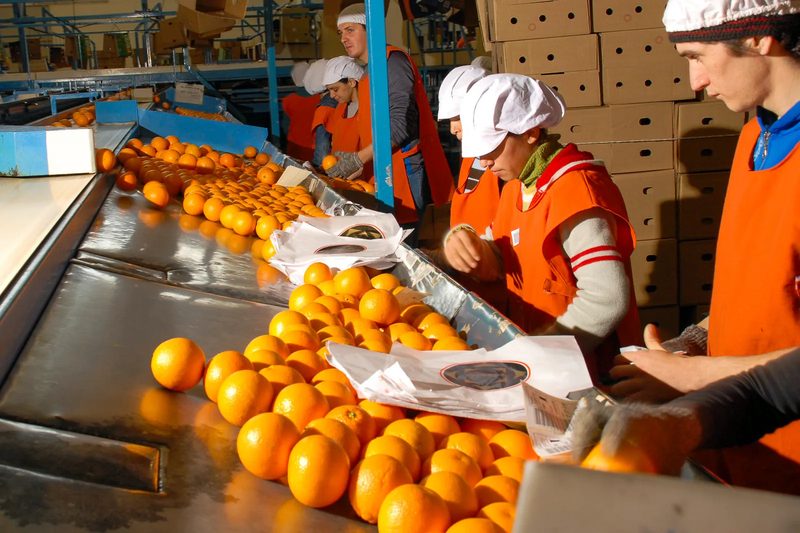
In the citrus packing plant · photo: Marcelo Cattani
uam_precios_tidy.csv948 KBuam_volumen_tidy.csv2.1 MBboletines_hist.csv65 KBchn_precios.csv11 KBine_ipc.csv31 KBuam_mensual.csv16 KBsalto_precios.json241 KBsalto_analisis.json61 KB
01 / 04
The datasets
Six CSV files (one row per observation, UTF-8, comma-separated) and the JSON the observatory reads. The UAM files are the official source reshaped into long format; the CPI is INE's official series; the other three are our own compilations from public sources.
-
Monthly wholesale prices, UAM
uam_precios_tidy.csv · 948 KBMonthly minimum and maximum by species and variety at Montevideo's wholesale market, in current pesos. The official Observatorio Granjero series, in long format (one row per product and month).
-
Volumes entering the UAM
uam_volumen_tidy.csv · 2.1 MBTonnes entering the wholesale market by species, variety and month. Use it to measure real seasonality and the weight of each product.
-
Twice-weekly bulletins, reference row
boletines_hist.csv · 65 KBFor each bulletin (Monday and Thursday), the min–max range of the reference row of each Salto product: grade I, medium size (or large if no medium), Uruguayan produce only. It feeds the preliminary months and the "This week" tile.
-
Central Hortícola del Norte prices
chn_precios.csv · 11 KBMinimum and maximum by product and trading day at Salto's CHN, extracted from the press chronicles of its wholesale offer report. Every row keeps the original sentence the price came from and the link to the article, for auditing.
-
Monthly headline CPI, INE
ine_ipc.csv · 31 KBConsumer price index, whole country, base October 2022 = 100, monthly series since 1937. The deflator behind every constant-peso price on the findings page.
-
UAM monthly bulletin, tables per product
uam_mensual.csv · 16 KBWholesale price and tonnes entered per product and month, with the same month's five-year average, the same month of the previous year and the previous month, as published in the monthly fruit-and-vegetable bulletin (parsed from the PDF). The only source with volumes more recent than the historical Excel files.
-
The observatory JSON
salto_precios.json · 241 KBThe file that draws the charts: 40 Salto product series with their monthly history (preliminary points flagged
"p":1), aboletinkey with the latest twice-weekly bulletin and achnkey with the latest Central Hortícola trading day and its history. The handiest format if you want to build on top of it. -
Findings JSON
salto_analisis.json · 61 KBEvery cross on What the data says, already computed: decade percentile in constant pesos per product, window and premium, volatility and price–volume correlation, the CHN months seen from the UAM, the gap per trading day and the parameters of the freight and CO₂ estimator.
02 / 04
Sources and licence
None of this is our own market survey: it is public data, reorganised and cross-referenced. The sources, always cited on every page:
Observatorio Granjero (DIGEGRA-MGAP / UAM agreement)
Monthly price and volume series for Montevideo's wholesale market since 2011, published as Excel files; the UAM 2025 yearbook; and the twice-weekly price bulletins in PDF. Its licence: reproduction permitted citing "Observatorio Granjero (convenio DIGEGRA-MGAP / UAM)".
Diario Cambio, Salto
Chronicles of the Central Hortícola del Norte's wholesale offer report, today the only public channel for those prices. Every extracted price keeps the original sentence and the link to the article.
Government of Salto, Monitor Productivo
Planting-intention survey (winter 2026), the basis of the planting intentions page (in Spanish).
Instituto Nacional de Estadística (INE)
Consumer price index, monthly series base October 2022 = 100, historical series. Used only as a deflator.
03 / 04
How every number is computed
Official monthly series
Monthly minimum and maximum by species and variety, as published by the Observatorio Granjero, in current Uruguayan pesos, not adjusted for inflation. These are Montevideo wholesale prices: the national reference the north trades against, not Salto prices and not retail prices.
Preliminary months
Between the latest official month and today, the series is completed with the monthly average of each product's reference row in the twice-weekly bulletins: grade I, medium size (or large if no medium, or the best grade-I row), Uruguayan produce only. Calibrated against May 2026: tomato and strawberry come out almost exact; citrus can drift up to 15 %, because the official figure seems to use the large size. They are flagged as preliminary in chart, table and tooltip, and replaced automatically when the official figure is published.
“This week”
The range of the same reference row in the latest published bulletin (Monday or Thursday). Not the product's global minimum and maximum, which mixes sizes and grades.
Seasonal index
For each product, the month's average divided by the year's average, times 100. A value of 130 in a month means 30 % above that product's annual mean. Being a ratio, it is inflation-neutral by construction.
Central Hortícola del Norte prices
From each chronicle we take, per product, the first per-kilo price that follows the mention of the product, stopping where the next product begins; prices per box, tray or bag are ignored. One price per product and trading day. Every CSV row keeps the sentence the number came from, so anyone can audit it. There are trading days only when the press covers them; it is not a daily series.
Salto–Montevideo gap
Midpoint of the CHN range divided by the midpoint of the UAM range of the same week, minus one. Positive, Salto dearer than the reference; negative, cheaper. It compares similar, not identical, grades: a signal, not a market measurement.
What it is not
Not volume-weighted averages, not including imported produce in the reference series, and not consumer prices. The UAM handles roughly 77 % of Uruguay's fresh-produce consumption, which is why it works as a reference; but a UAM price is not “the price in Uruguay”.
04 / 04
How to cite
"Salto agrifood price observatory, saltouruguay.com, from data of the Observatorio Granjero (DIGEGRA-MGAP / UAM agreement) and the Central Hortícola del Norte offer report via Diario Cambio. Accessed [date]." Questions about the data: mathias.nicola@visitsalto.com.
05 · Contact
Questions about the data
If you publish something with these files, let us know: we want to see what gets built on this.