Grow · COMAP · Updated: 30 September 2026
COMAP, explained from Salto.
Uruguay lets a company deduct between 30% and 100% of what it invests from its corporate income tax, if the project goes through the Investment Law's application commission, COMAP. Since 1 February 2026 a new decree, 329/025, is in force. This page explains what it exempts, how projects are scored, what doing it in Salto adds, and what it has to do with the OECD. Everything is sourced and dated; the scoring examples are our own arithmetic with the official formula.
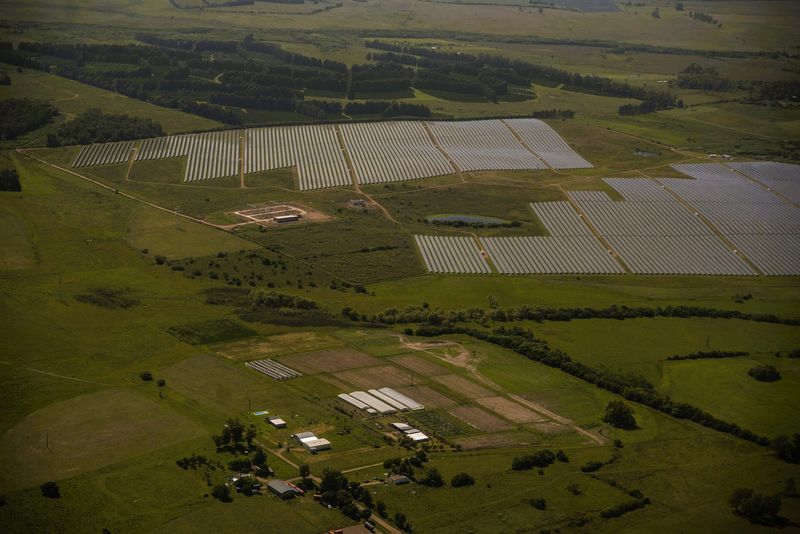
La Jacinta solar farm, near Termas del Daymán · real photo
01 / 06
What COMAP is and what changed in 2026
Law 16,906, of January 1998, declares the promotion and protection of investment to be in the national interest and creates the application commission, COMAP: the Ministry of Economy, which coordinates it, plus Industry, Agriculture, Labour, Environment, the planning office (OPP) and the Decentralisation Commission. The company files a project, COMAP scores it and recommends, and the executive declares it promoted. Article 16 of the law already says that projects contributing to decentralisation receive higher benefits in length or amount.
The regulation in force is Decree 329/025, signed on 23 December 2025 and effective from 1 February 2026, which replaced Decree 268/020. What changed, in short: micro and small companies add 15 percentage points of exemption and two more years, with no investment cap keeping them out; medium companies of up to 50 employees add 10 points and one year; large projects (over 180 million indexed units, UI) filed before the end of 2027 can reach 100% exemption; the time allowed to execute the investment fell from ten years to five; and the scoring matrix was reweighted, with decentralisation dropping from 15% to 10%. The operating detail is in the General Operating Criteria of 29 May 2026.
How a project is filed
- It is filed through the electronic single window. The application carries company details, accounts and a sworn statement, at vui.gub.uy.
- A ministry assesses it by sector. Economy for commerce and services, Agriculture for farming, Industry for industry, Tourism for tourism. The innovation agency ANII scores the innovation indicator.
- COMAP has 90 working days to recommend. The clock stops while it asks for information, up to 60 days. If it runs out with no ruling, the recommendation is deemed favourable.
- The company can start using the benefits. It may settle its taxes as if they were already approved while it waits for the resolution.
- Then, annual follow-up. A sworn statement each year with the investment executed, the benefits used and the indicators. Tolerance on the committed score is 10%; up to three extensions per project.
02 / 06
What it exempts
| Tax | Benefit | Detail |
|---|---|---|
| IRAE (corporate income tax) | Between 30% and 100% of the amount invested is deducted from the tax | The percentage comes from the score. In any year up to 90% of the tax due can be used; the remaining 10% is paid. Period of use: 4 to 25 years depending on amount and score. |
| Wealth tax (Impuesto al Patrimonio) | Movable assets: their whole useful life. Civil works: 8 years in Montevideo, 10 in the interior | The interior's two extra years apply to any project in Salto, regardless of the score. |
| VAT | Refund of VAT on civil-works materials and services and on the project's movable assets | Through tax-credit certificates. |
| Import duties and taxes | Full exemption, VAT included, on goods that do not compete with domestic industry | With a certificate from the National Directorate of Industry. |
03 / 06
How a project is scored
Each indicator scores 0 to 10 and is multiplied by its weight. The weights add up to 130%, so the maximum weighted score is 13. Getting in takes 1 weighted point, which must come from jobs, exports, sustainability, innovation or the strategic indicator: decentralisation does not count towards the minimum, but it does count towards the percentage and the years.
| Indicator | Weight | How it is measured |
|---|---|---|
| Job creation | 40 % | new jobs relative to the investment; 5-year commitment; up to 1 extra point for women, young people, people with disabilities |
| Decentralisation | 10 % | by the department where the investment sits; Salto: 8 points |
| Export growth | 15 % | goods and services; 3-year commitment |
| Environmental sustainability | 20 % | 1 point per 5% of qualifying investment; extra for LEED, BREEAM or the energy-efficiency label |
| I+ (technology, innovation, R&D) | 20 % | assessed by ANII; up to 10 points for experimental R&D |
| Strategic indicator | 25 % | activities each ministry defines: irrigation, aquaculture, bio-inputs, tourism, decarbonisation, green hydrogen, aerospace, domestic industry |
| Total | 130 % |
The formula
- Share of income tax exempted = (score − 1) ÷ 9 × 0.7 + 0.3, capped at 1.
- Period in years = (score − 1) ÷ 9 × (bracket ceiling − 4) + 4.
- The bracket ceiling depends on the amount: 16 years up to 3.5 million UI, 17 up to 14 million, 18 up to 70, 20 up to 140, 22 up to 250, 24 up to 500 and 25 above. Two or more innovation points add two years, within the ceiling.
04 / 06
The northern bonus: what investing in Salto adds
The decentralisation indicator is built from each department's informality rate, unemployment, and monetary and multidimensional poverty; Montevideo is excluded from the calculation and scores 0. This is the table in Decree 329/025:
| Points | Departments |
|---|---|
| 10 | Artigas, Treinta y Tres |
| 9 | Cerro Largo, Río Negro |
| 8 | Salto, Tacuarembó, Paysandú |
| 7 | Rivera |
| 6 | Rocha, Soriano |
| 5 | Lavalleja, San José |
| 4 | Canelones, Florida |
| 3 | Durazno, Maldonado |
| 2 | Colonia, Flores |
| 0 | Montevideo |
What it is worth in practice (our own arithmetic with the official formula)
Salto has 8 points at a 10% weight: 0.8 weighted points that Montevideo does not get. A project scoring 4 weighted points in Montevideo gets a 53% income-tax exemption; the same project in Salto scores 4.8 and gets 60%: 6.2 percentage points more of the investment deducted from the tax.
On the period, that same project, in the 16-year bracket, goes from 8 to 9 years to use the benefit. And civil works are exempt from wealth tax for 10 years instead of 8, regardless of the score.
Under the previous decree the bonus was larger: Salto had 10 points at a 15% weight, 1.5 weighted points. Decree 329/025 gave it 8 points at 10%. The gap with Montevideo, which went from 4 points to 0, is still what makes the difference.
What does not exist
What else sits close to Salto
Micro and small companies
15 percentage points more exemption and two more years; medium companies of up to 50 employees, 10 points and one year. Added in the new decree with no investment cap.
The strategic indicator
Worth 25%, it rewards irrigation, aquaculture, bio-inputs, livestock improvement, tourism services and infrastructure, energy efficiency and decarbonisation, green hydrogen, life sciences and aerospace. Much of that list is what Salto already has or can have.
Environmental sustainability
20% of the score for the share of the investment that qualifies, with extra points for certifications. In the department with the highest solar irradiation in the country, the qualifying share comes naturally.
Tourism
Tourism projects may choose, tax by tax, between this regime and Decree 175/003. In 2026 the Club Remeros Salto went through COMAP with US$1.65 million of promoted investment.
05 / 06
What the OECD has to do with it
Uruguay is not an OECD member and has not applied to be one. As of 30 September 2026 there is no formal application, no accession process opened by the Council, no roadmap and no committees assigned. What there is, with dates: in December 2025 minister Oddone revived in Paris a work agenda dormant since 2020; on 9 April 2026 the Ministry of Economy requested, for the first time, an OECD Economic Survey of Uruguay, two years long and financed by the IDB, to measure the distance between Uruguayan rules and the organisation's standards; the OECD proposed a memorandum of understanding the government has not yet signed; and on 28 and 29 September the secretary-general, Mathias Cormann, was in Montevideo and said the memorandum does not mean starting an accession process, and that past accessions took three to five years. The Ministry of Economy itself sums up the relationship in three strands: the global minimum tax, a technical programme on the labour market and quality employment with the planning office (OPP) and the training institute (INEFOP), and the economic survey; and it recalls that Uruguay has been a full member of the OECD Development Centre since 2015 and has adhered to the international tax-transparency frameworks since 2009. The government will open a debate on the relationship in early 2027 (MEF, 28 September; Búsqueda, 24 September; En Perspectiva, 29 September; Búsqueda, 28 September).
What does tie COMAP to the OECD is written in two places. The first is the global minimum tax, the OECD's Pillar Two: Law 20,446, of December 2025, created the domestic minimum top-up tax, which makes multinational groups with revenue above 750 million euros pay an effective 15% rate in Uruguay, and Decree 206/026, of August 2026, adjusted how companies with fiscal-stability clauses are compensated. The Ministry of Economy said on 28 September that the OECD qualification of that tax is in its final stage, for formal integration in 2027. The effect on COMAP is concrete and narrow: for a multinational of that size, any income-tax exemption beyond the 15% margin is offset by the top-up tax; for every other company, which is almost every project that goes through COMAP, nothing changes (EY, January 2026; Decree 206/026; La Mañana, July 2026).
The second is what the OECD has already said about the regime. Uruguay has adhered since February 2021 to the OECD Declaration on International Investment and Multinational Enterprises, and sits on the Investment Committee for that declaration. In its Investment Policy Review of Uruguay, from 2021, the OECD described COMAP as a project-by-project incentive, put the cost of Law 16,906 at 0.2% of GDP in 2017, and recommended streamlining the incentive schemes, publishing what they cost and granting incentives only by law. If Uruguay ever entered an accession process, that committee and the fiscal-affairs committee would review this regime: that is how every accession works. But that is what would happen, not what is happening: no government or OECD document links Decree 329/025 to accession.
06 / 06
Figures and sources
| Period | Projects recommended | Promoted investment |
|---|---|---|
| 2025 | 1,207 | US$6,878.5 million, of which 5,385 is a single HIF project in Paysandú; without it, about 1,493 million |
| January to June 2026 | 951 | US$1,137.3 million, more than twice the projects and almost four times the amount of the same half of 2025 |
The Ministry of Economy's spreadsheets do not carry each project's department, so the Salto projects cannot be counted. By company name, 2026 shows the Club Remeros Salto (tourism, US$1.65 million, May) and two projects from the Sanatorio Médico Quirúrgico de Salto (about US$200,000 each, June). That is a sample by name, not a departmental figure. The last official split dates from 2022: 69% of promoted investment in the interior, 31% in Montevideo.
In the north, the two large projects of these two years are HIF in Paysandú (US$5,385 million, synthetic fuels) and BrasPine in Rivera (US$237 million, pine timber). Projects filed, which outnumber those recommended, were 1,991 in 2025 for US$14,626 million and 1,175 in the first half of 2026 for US$3,120 million (la diaria, 10 August 2026).
Sources: Decree 329/025 (IMPO) · General Operating Criteria, 29 May 2026 (MEF) · Law 16,906 (IMPO) · Regime page and statement of 8 January 2026 (MEF) · Presidency, 19 January 2026 · El Observador, 7 April 2026 (the investment map) · Projects recommended 2025 and first half of 2026 (MEF spreadsheets) · El Observador, 9 April 2026 (the Economic Survey) · OECD, Uruguay's adherence to the Investment Declaration, 2021 · Scoring examples are our own arithmetic with the formula in the Criteria. Updated: 30 September 2026.
What comes next
A project in Salto
The department's full case, with the energy, the land and the aerospace sector, is in Invest in Salto; and the things nobody has done here yet, in Ideas to build in Salto. If you have a project and want it told, or found a mistake on this page, write to us.